
Docs/Historical SQL Quickstart
API quickstartsHistorical SQL Quickstart
Run a bounded, authenticated Historical SQL request against RawOptionTrades and recover safely from validation, read-limit, or timeout errors.
On this page
Historical SQL accepts read-only SELECT queries over HTTPS. The endpoint applies server-owned row, byte, and execution-time limits, and every visible trade is delayed by at least 15 minutes. Paid (active) access covers only the past 15 days (360 elapsed hours, including weekends and holidays). Older trades are excluded before aggregation; trial access is unchanged. See the Historical API reference for the complete policy.
1. Start with a bounded query
This query filters by trading date and symbol, selects explicit columns, and limits output:
SELECT date, time, symbol, put_call, strike, expiration_date, size, price, bid, ask
FROM RawOptionTrades
WHERE date = (
  SELECT max(date) FROM RawOptionTrades
  WHERE symbol = 'AAPL' AND date >= today() - 7
)
  AND symbol = 'AAPL'
ORDER BY time DESC
LIMIT 20
Filtering by date and symbol helps ClickHouse prune work. LIMIT caps returned rows, while OptionData's server-enforced read limits bound the scan itself. Bound a latest-date lookup the same way, or read the latest date from RawOptionTradesMaxDateOnlyMV: an unbounded SELECT max(date) FROM RawOptionTrades reads the whole table and returns QUERY_TOO_BROAD.
2. Send the request
Store the key in OPTIONDATA_API_KEY, then use the canonical bearer header:
curl -X POST https://www.optiondata.io/api/historical/sql \
  -H "Authorization: Bearer $OPTIONDATA_API_KEY" \
  -H "Content-Type: application/x-www-form-urlencoded" \
  --data-urlencode "sql=SELECT date, time, symbol, put_call, strike, expiration_date, size, price, bid, ask FROM RawOptionTrades WHERE date = (SELECT max(date) FROM RawOptionTrades WHERE symbol = 'AAPL' AND date >= today() - 7) AND symbol = 'AAPL' ORDER BY time DESC LIMIT 20"
A successful response has status: "SUCCESS", a data array, and entitlement/limit information in meta.
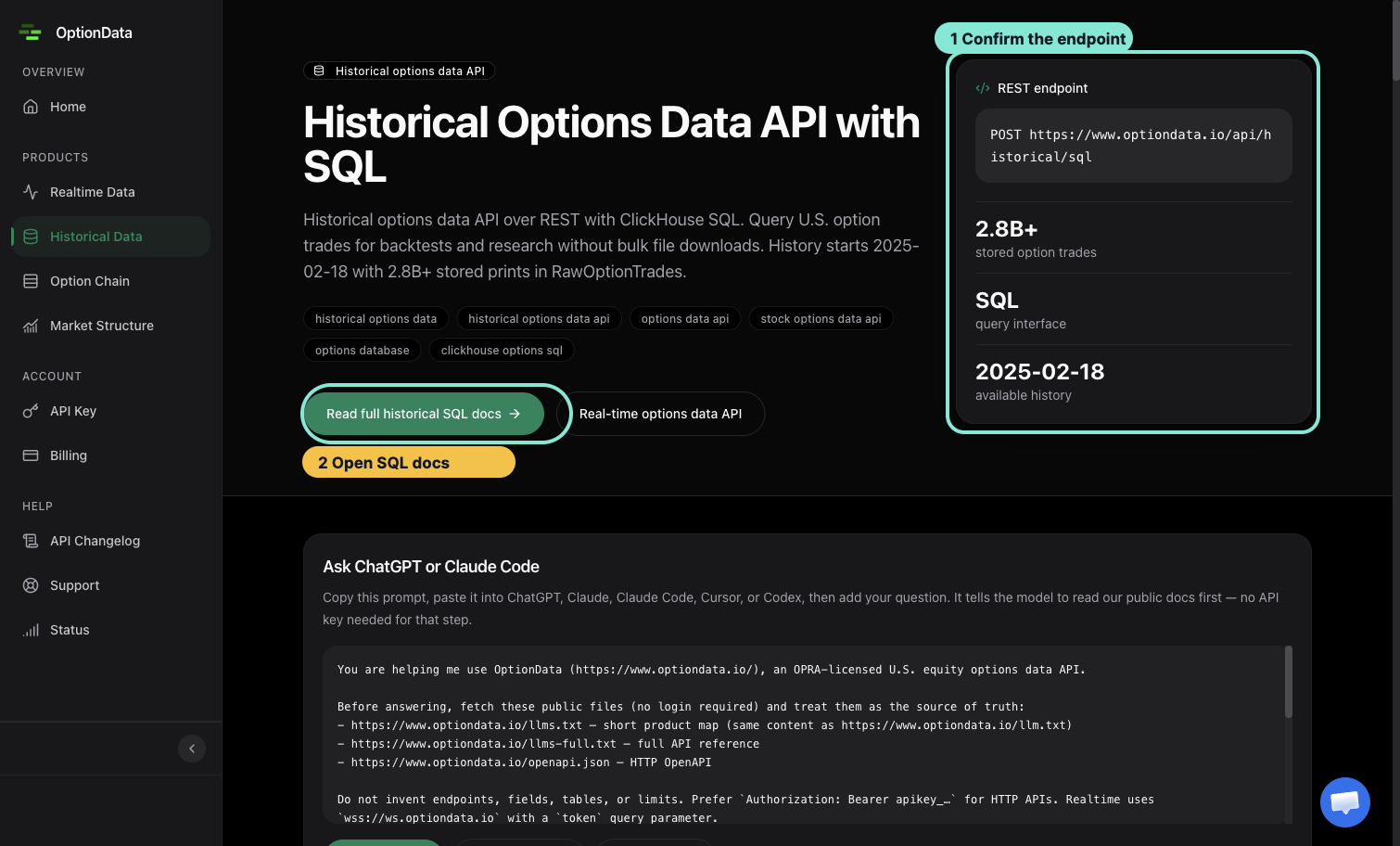 Select the image to view it at full size.
Start from the documented REST endpoint, then use the bounded query shown below.
Trial responses cover the past 7 days and are capped at 1,000 rows even when the SQL uses a larger LIMIT.
3. Keep queries safe
- Query only published, whitelisted tables and columns.
- Filter by
dateandsymbolbefore widening the request. Paid queries must target the past 15 days; a range crossing that boundary includes only eligible trades. - Select only the columns you need.
- Include a reasonable
LIMIT. - Do not include semicolons, SQL comments, mutations,
UNION, or query-levelSETTINGS.
The public Historical Option Trades API reference is the schema source of truth for this restricted endpoint; system-table discovery is not part of the customer query surface.
4. Recover from errors
| Status | Meaning | Next action |
|---|---|---|
400 | SQL failed the public query guard | Correct the statement or column names |
401 | Missing or invalid API key | Check the bearer header |
403 | No active/trialing Pro entitlement | Review Billing |
422 QUERY_TOO_BROAD | Server scan limits were exceeded | Follow reason / hints; narrow filters or split the time window before retrying |
422 INVALID_QUERY | ClickHouse rejected the expression | Correct the reported query problem |
429 | Rate limited | Honor Retry-After |
504 | Query timed out | Split the request into smaller windows |
For QUERY_TOO_BROAD, the response includes reason: "SCAN_LIMIT_EXCEEDED" and deterministic hints. Narrow the date range, add selective filters such as symbol, or split a large request into smaller time windows before retrying. Avoid automatically retrying the same unchanged query.
LIMIT is still recommended to cap returned rows, but it does not necessarily reduce the number of rows the server must scan. Do not treat a smaller LIMIT as the primary fix for QUERY_TOO_BROAD.
Ask ChatGPT or Claude Code
Copy this prompt, paste it into ChatGPT, Claude, Claude Code, Cursor, or Codex, then add your question. It tells the model to read our public docs first — no API key needed for that step.
You are helping me use OptionData (https://www.optiondata.io/), an OPRA-licensed U.S. equity options data API.

Before answering, fetch these public files (no login required) and treat them as the source of truth:
- https://www.optiondata.io/llms.txt — short product map (same content as https://www.optiondata.io/llm.txt)
- https://www.optiondata.io/llms-full.txt — full API reference
- https://www.optiondata.io/openapi.json — HTTP OpenAPI

Do not invent endpoints, fields, tables, or limits. Prefer `Authorization: Bearer apikey_…` for HTTP APIs. Realtime uses `wss://ws.optiondata.io` with a `token` query parameter.

Products:
- Realtime trades WebSocket: wss://ws.optiondata.io
- Historical SQL: POST https://www.optiondata.io/api/historical/sql
- Option chain: POST https://www.optiondata.io/api/option-chain
- Market structure: GET https://www.optiondata.io/api/v1/market-structure/{symbol}

I am asking about: Historical SQL Quickstart
- Markdown: https://www.optiondata.io/md/historical-sql-quickstart
- HTML docs: https://www.optiondata.io/docs/historical-sql-quickstart

My question: